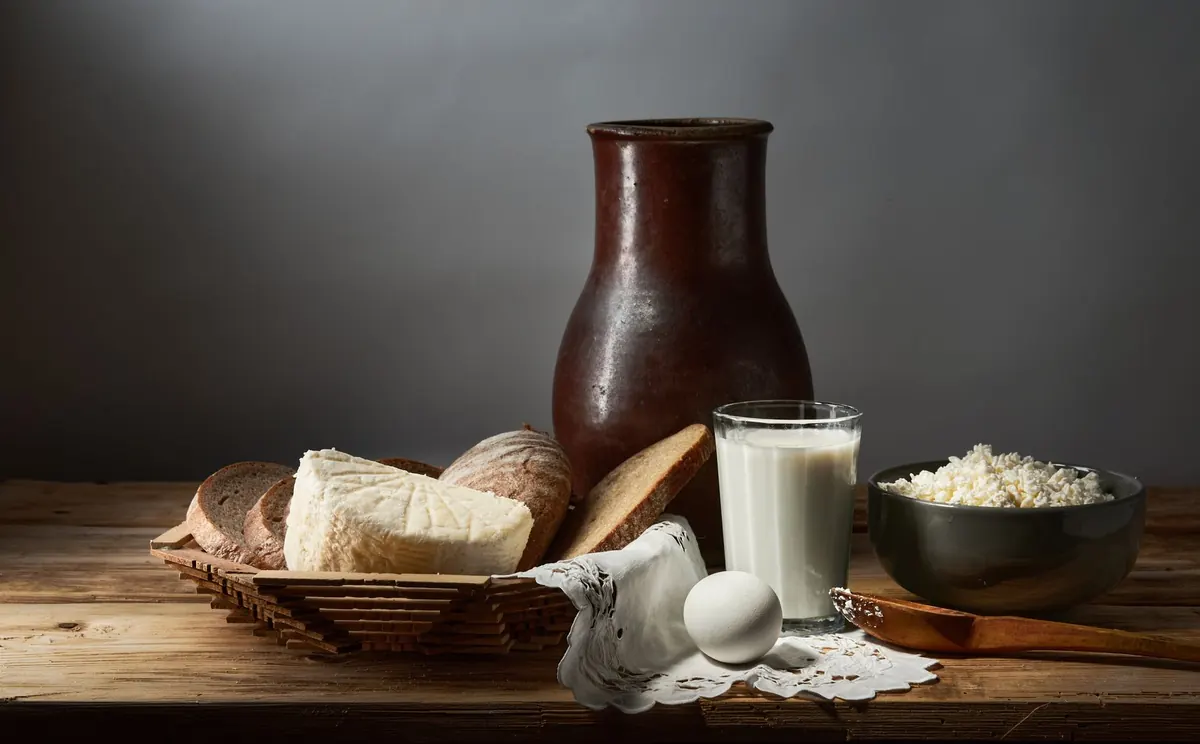
Market shopping rewards attention. The eggs, cheese and bread in front of you have a history — how long they have sat, how they have been stored, who made them — and much of that history is legible if you know where to look. None of it requires equipment. It requires about thirty seconds, two fingers and a willingness to ask a direct question. What follows is what experienced shoppers actually check, staple by staple.
Eggs are the hardest of the three to read, because the shell hides almost everything. Almost, not everything.
A fresh egg has a matte, faintly chalky shell that feels slightly rough under your thumb. An older one looks polished, thin and glassy. Pick two eggs of the same size from opposite ends of the tray and you can sometimes feel the difference in weight: as an egg ages, moisture escapes through the pores and the air pocket inside grows, so it becomes lighter.
Skip anything cracked, damp, or sitting in a puddle that has leaked from a neighbour. A dirty shell is not automatically a problem — free-range eggs often are — but a sticky, damp one is. Check the display as well: a tray of eggs in direct sun on a warm morning tells you something about how the rest of the stock is treated. Ask how often the tray is restocked.
Good stalls answer that question with a date of their own. A chalkboard reading "collected Tuesday" or a carton stamped with a laying date is worth more than any claim about freshness, because it is a fact rather than an adjective. If the eggs are sold loose from a basket, ask how many days' worth is out at once; a small tray refilled often beats a pyramid that has stood there since dawn.
At home, a single cracked egg in a saucer tells you about the rest. A very fresh egg has a thick white that mounds up around a yolk sitting proud and firm; an old one spreads out flat like water and the yolk flattens with it. A white that looks pink or faintly iridescent is a reason to bin the egg, not to stir it in.
This one happens at home. Fill a glass with cold water and lower an egg in gently.
The test is a rough guide to age rather than a guarantee. Your nose is a better final check: crack the egg into a separate bowl first, and if it smells sour or sulphuric rather than simply of egg, throw it out. If you are pregnant, elderly or cooking for someone with a weakened immune system, follow local food-safety advice on eggs and ask the vendor how they have been stored.
Storage matters as much as the buying. Eggs keep best at a cool, steady temperature, and the fridge door — swinging open twenty times a day — is the worst place in it. Buy a dozen you will eat within a fortnight rather than thirty that sit forgotten behind the milk.
Cheese is the most talkative of the three. A cut face shows how long the piece has been exposed, how it has been handled, and whether it came from a fresh wheel or a tired one.
Mozzarella should be pearly and springy, sitting in a little of its own milky liquid. It should smell of milk and nothing much else. If the liquid has gone cloudy or the surface has yellowed at the edges, it has been out too long. Ricotta should look moist and slightly granular, not weeping into the tub, and should taste clean and creamy. A sour, sharp or faintly ammonia note is not a style — it is a warning.
The same reading applies to feta, goat's cheese logs and anything else sold from a tub. Feta should sit in clean brine, not cloudy water, and should crumble rather than smear. A fresh goat's cheese should be snow-white and faintly lemony; a log that has yellowed, slumped, or stuck to its paper has been in the case too long.
Look at the rind first. It should be intact, dry in the way its type demands, and free of cracks opening into the paste. Slime, unexpected fuzz, or a rind lifting away from the cheese are all reasons to move on. A washed-rind cheese is meant to be sticky and orange, but it should not be wet or smell of the drain. Blue should show its veining through the paste, not as a separate grey layer creeping across the cut face.
Then look at the cut face: dense and even, with the small eyes or blueing you would expect. If the edges look dry, chalky or curled, that piece has been sitting cut and uncovered for hours. Ask for a fresh cut rather than accepting the tired end piece — and watch how it is done. A vendor who wipes the knife, cuts into the middle of the wheel and hands the piece over face-up is looking after the cheese.
Smell matters more than most people expect. A good aged cheese smells of butter, hay, nuts, or the cellar it was aged in. Ammonia means it has been wrapped too tightly or left too long. Taste before you buy where the vendor offers it — a competent one will cut a sliver from the middle of the piece, not from the dried edge.
Buy in pieces you will finish. A generous wedge looks like better value until half of it goes hard at the back of the fridge; a smaller piece bought twice is usually the cheaper route. Ask for paper rather than cling film for anything with a rind, and let the cheese come to room temperature before you judge it — cold mutes flavour and makes a good cheese taste of nothing much at all.
Bread gives you three signals in quick succession: sound, touch and smell.
Turn the loaf over and tap the base with your knuckles. A properly baked loaf sounds hollow and dry, like knocking on a wooden door. A dull thud means the middle is still heavy with moisture and the crumb will be gummy. Then press the side gently with two fingers: it should spring back and fill the dent, not stay compressed. The base should be dry and evenly coloured. A pale, soft base means it was underbaked or has been sweating in a plastic crate; a damp one means it has been sitting in its own steam.
Crust colour is a useful shorthand. A well-baked loaf is uneven — darker where it caught the heat, paler in the folds — and looks like it came out of an oven rather than a mould. A uniformly blond crust on a country loaf usually means a timid bake and a crumb that will stale from the inside out.
Smell the crust. It should be toasty and wheaty, with a faint sourness if it is a sourdough and none if it is not. Old oil and cool, flat dough are not good signs. Ask what time it was baked. Bread out of the oven at four in the morning is at its best by nine and drying by late afternoon — which is fine, as long as you know and buy accordingly. A loaf you will finish in two days beats a week's supply going stale in the cupboard.
Two small habits help. Buy unsliced and cut it at home, since cut surfaces dry out fast. And avoid any loaf that has been bagged while still warm; the condensation turns a good crust soft within hours. If you only need half, ask for half — most bakers would rather sell you a small loaf than have you remember the one that went mouldy.
People who make or raise what they sell generally like being asked, and the answers tell you as much as the produce does. Four questions cover most of it.
Listen to the shape of the answer as much as the content. A vendor who checks the tray, names a day, or admits the blue is a little past its best is giving you something worth trusting.
The best stallholders answer a question with a question of their own — what are you cooking, when will you eat it — because that is what decides which piece you should take.
The food is only half the evidence. Look at how the stall is run. Cheese knives kept clean and separate, cloths that are changed rather than merely folded, eggs shaded from the sun, loaves turned so no cut faces sit on display: these are the habits of people who expect to see you again next week.
Watch the money, too. A vendor who handles cash and then handles your cheese without a wipe or a sheet of paper is telling you how the rest of the day goes. Queues matter for the same reason — a stall with a steady line is turning its stock, and turnover is the best preservative there is. A lonely display of tired wedges at three in the afternoon is the opposite.
Timing helps. Bread is best bought early, but not at the very start, when the first bake is still warm and the second is not yet out; mid-morning is often the sweet spot. Cheese can be bought at any hour, though a vendor at the end of a long day may be glad to cut you something fresh rather than sell the dried edge. Be wary, all the same, of the late bargain on anything that looked doubtful at eleven.
Finally, buy smaller and more often than feels natural. Markets reward the shopper who comes back: three eggs, a wedge and a half loaf this week, the same again next, is a better arrangement than a fortnight's stock turning in the bag. Freshness is not a property you can inspect once and then own. It is a relationship with a stall, and it is renewed every Saturday.
Photo: Matvei / Pexels

A practical guide to shopping local markets in the rain: when to go, which produce survives the wet, how to layer...

A practical guide to the seven mistakes that trip up first-time market shoppers—from arriving too late to...

Atmosphere, stock, haggling rules and budget habits compared, so you can pick the right market for a Saturday...


Discover the best gems of the market.
