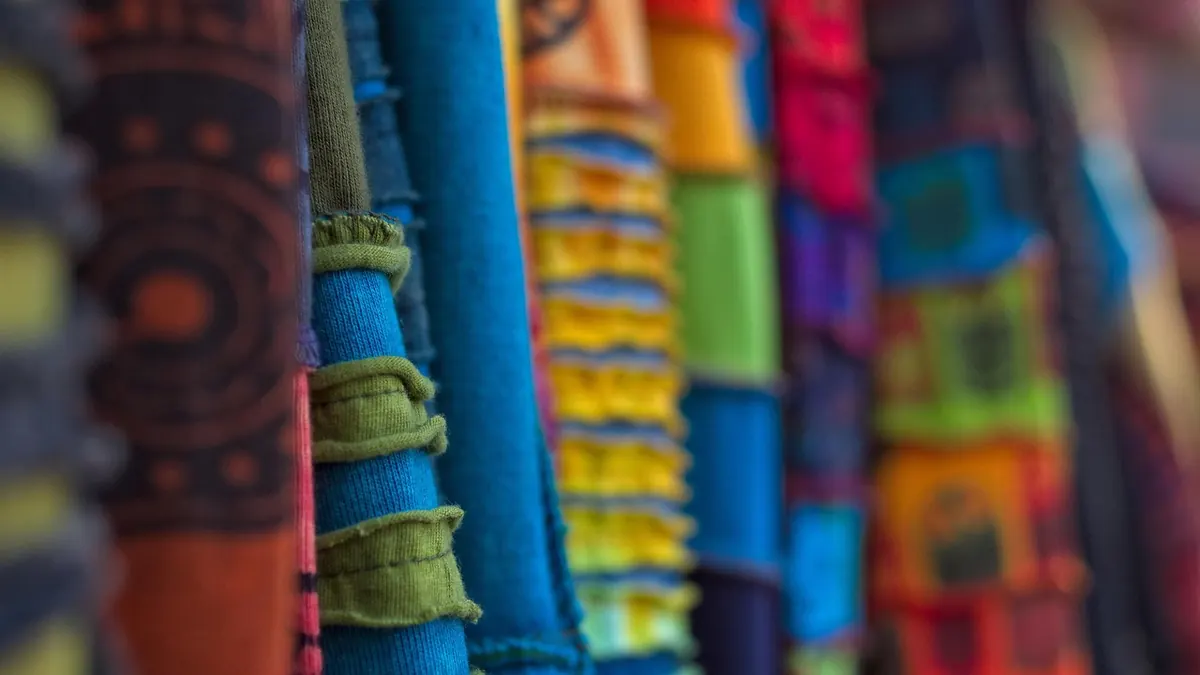
Run the back of your hand across the cloth before you ask the price. That single gesture tells you more than any sign on the stall. Handwoven cotton has a faint, irregular ripple to it; a factory poplin feels glassy and even. Neither is automatically better, but knowing which one you're holding changes what a fair price looks like — and how you'll look after it at home.
The selvedge is the fastest tell. On a power loom it runs in a tight, uniform line, often with a row of tiny woven-in dots where the machine gripped the fabric. A handloom edge is slightly wavy, and you'll usually find small loops or a short fringe where a weft thread was turned back by hand. Turn the cloth over, too: hand-blocked fabric often carries faint traces of the same pattern on the reverse, slightly offset.
Hold a length up to the window. Factory weaving is remarkably consistent across the whole width. Handloom fabric breathes unevenly — a thicker thread here, a looser band there. That variation is the signature, and it's also why handloom cloth tends to fall in soft folds rather than stiff planes. Slubs woven in deliberately are a design choice; slubs that appear at random are usually the loom talking.
Print is the third clue. Screen-printed repeats land with mechanical precision, and registration marks near the selvedge are a giveaway that a machine ran the pattern. Block prints show the hand: motifs a millimetre off, a sliver of overlap where a block was pressed twice, an edge that's crisp on one side and softer on the other. None of that is damage. It's just a different way of putting colour on cloth.
Look inside. Mass-produced clothing is usually overlocked at the edges — a close, uniform row of loops that stops fraying and takes seconds to run. Artisan workshops more often use French seams, flat-felled seams or a bound edge. All of these take longer and leave a cleaner interior. None is automatically stronger, but the choice tells you how much time went into the piece.
Hems are another quiet indicator. Factory hems tend to be narrow, a single fold stitched fast. Hand-finished hems are deeper, with a slightly uneven stitch line visible on the inside, because someone turned and pinned them. Check the pattern at the side seams as well: on a well-made factory garment the motifs meet precisely, and on a cheap one they don't. A hand sewer may accept a small compromise at the seam to avoid wasting cloth — ask, and most will happily explain why.
Then the trims. Buttons on handmade garments are often stitched with a small shank, a little stem of thread so the button sits above the fabric, and secured with a few extra passes. Cut a button off a cheap factory shirt and you'll find one loop of thread and a ring of pulled fabric. Zips are less romantic: a good metal or coil zip is a good zip whoever inserted it, so judge how neatly it's set rather than what it's made of.
Imperfection is not proof of craft. Sloppy work exists at every price point, so learn to separate the two.
A handwoven throw can take a weaver days. Add the sampling, the small dye lots that never get a volume discount, the natural dyes that yield less colour per batch, and the offcuts nobody can sell on. That's before anyone has priced their own time. Factory cloth spreads those costs across thousands of metres; a workshop spreads them across a dozen pieces.
Price alone proves nothing, though. Expensive factory goods exist with a story attached. Ask instead: who made this, what fibre is it, how should I wash it, and can it be repaired? A seller who answers in specifics — the region, the loom, the dye — is telling you something useful. Vague poetry about heritage is not. It also helps to think in cost per wear: a well-made shirt you mend and wear for years often works out cheaper than three that pill and go thin.
Factory production has real strengths. Industrial machines hold thread tension far more consistently than hand stitching, fabrics are uniform, and stress points are reinforced to a set standard. Its weak spots are the ones you'd expect: thin fabric, shallow hems, printed surfaces that crack, plastic zips, and seams that pull because there's no allowance to let out.
Handmade pieces tend to use heavier cloth and deeper hems, and the seam allowances often leave room for alteration later. Natural fibres age rather than fail. The vulnerabilities are equally real: natural dyes fade and can bleed in the first washes, handloom cotton may shrink noticeably, an uneven weave can abrade faster at cuffs and underarms, and a hand-stitched seam will fail if the thread was poor to begin with. The most durable choice is usually the one you can repair, so check whether the maker offers mending or can tell you who does.
Read the fibre before the care label; the label tells you what the cloth is, not how well it was made.
If the seller can't tell you how to wash something they made, treat that as information too.
Factory-made isn't the enemy; buying blind is. A cheap, well-cut garment in a decent fibre can serve you for years, and a costly handmade piece can be a poor buy if it doesn't fit or you won't care for it. Use your hands, ask two direct questions, and let the answers decide. Buy less, choose the cloth you actually want to touch, and learn the small repair that keeps it going.
Photo: CryptoWolf / Pixabay

A practical guide to shopping local markets in the rain: when to go, which produce survives the wet, how to layer...

A practical guide to the seven mistakes that trip up first-time market shoppers—from arriving too late to...
Atmosphere, stock, haggling rules and budget habits compared, so you can pick the right market for a Saturday...


Discover the best gems of the market.
